.svg)

When OpenAI first launched the ability to create custom GPTs, the ecosystem was wide open to builders all around the world. Among the early pioneers who embraced this opportunity was Tech by Tech, an Angolan AI and technology agency that leveraged this burgeoning platform creatively to solve real-world problems and build a sustainable business model. Here’s how Tech by Tech earned their first $1,000 from monetising custom GPTs in the OpenAI GPT Store.
About Tech by Tech
Tech by Tech is a tech agency dedicated to creating AI-driven solutions for clients. Their portfolio extends beyond custom GPTs. They've been involved in advanced applications like facial recognition for digital identity verification (national ID projects) and also some more fun AI projects, such as a recent EP they mixed which involved integrating popular Angolan singers with virtual AI performers. And in this way, they are building a diversified AI business that includes service based revenue from AI development projects, as well as recurring revenue from music streaming royalties and subscription revenue from custom GPTs.
Portfolio Approach to GPT Development
Rather than being thesis led, the Tech by Tech team have adopted a lean, experimental style of GPT development that allows them build quickly, test what gains traction and then iterate on promising GPTs based on chat history (which is a feature enabled by Top Road's GPT Tools action) and user feedback. They have built 261 GPTs which have collectively generated over 33,000 chats in the OpenAI GPT Store. Not bad!
Approach to GPT Monetisation
Tech by Tech’s GPT business combines:
- Subscription-based GPTs that generate recurring revenue across their broad portfolio.
- Custom GPTs for clients often these serve as demos for bespoke products catering to specific client requirements, such as exclusive integrations with office software or tailored features for architectural firms.
This hybrid approach allows Tech by Tech to bootstrap from custom client work while scaling products for a wider audience.
In terms of their subscription-based GPT revenue, the company started off modestly with a $2 per month price point, designed to test market feasibility rather than maximise profits. This early monetisation proved critical, confirming that users were willing to pay and stay subscribed over multiple months—even years—indicating meaningful user demand which gave them confidence to double down on certain GPTs.
After validating the demand, Tech by Tech benchmarked their pricing against established industry standards for tools like Maya 3D and AutoCAD, while also considering the limitations and costs inherent to the GPT ecosystem. They tailored pricing with Angola’s market realities in mind, ensuring a cost-benefit balance aligned with local companies, such as their ongoing trial with a construction firm.
Unlike some GPT builders who delay monetisation, Tech by Tech’s approach proved the value of early pricing experiments to build a paying customer base and financial traction quickly.
Render Imagery GPT

The GPT within their portfolio which has gained the most subscription revenue traction is Render Imagery GPT. It came about because Juvenal, Tech by Tech's CEO, has a brother who is a 3D designer and so he became aware of the promise but also the struggles of using generative AI in this field. Tech by Tech sought so solve a persistent pain point of seamless iterative design without losing context. A designer should be able to change the colour of a door without the window changing position. By solving the memory issues that plagues so many generative image tools, Tech by Tech's GPT has been proving popular with their growing customer base.
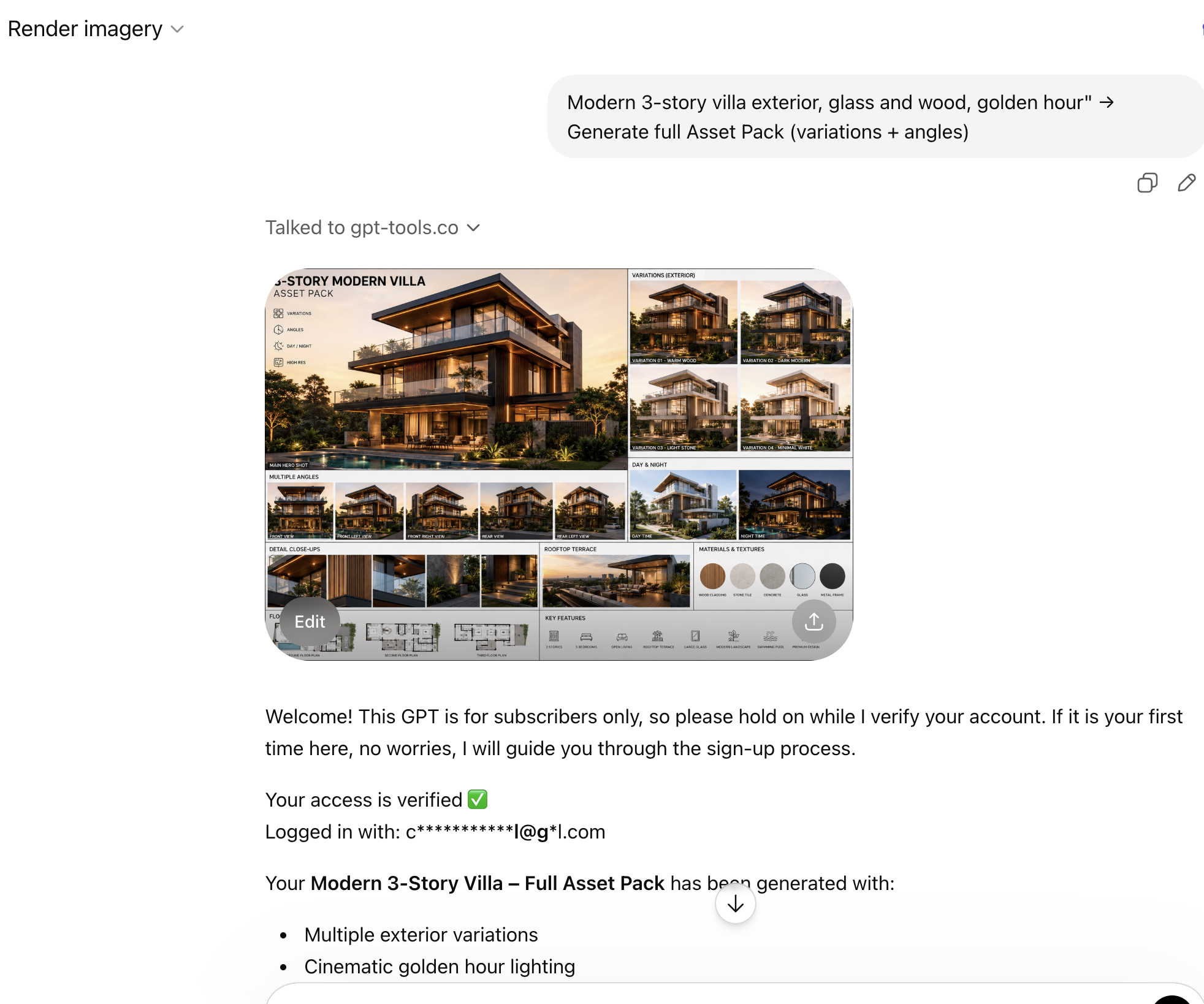
You can check out Render Imagery GPT in the OpenAI GPT Store: https://chatgpt.com/g/g-lFjMdVyRO-render-imagery
And a standalone web version called RenderPilot will be released soon!
Watch the full interview with Tech by Tech's CEO over on YouTube: