.svg)

When OpenAI launched the ability to create custom GPTs, it opened up a new path for domain experts to turn their knowledge into practical AI-powered products without needing to write code.
One such person was Dr Joseph Odongo, a Kenyan biosafety expert with a PhD in molecular microbiology and biotechnology, who could see the opportunity for AI to accelerate scientific research.
Solving His Own Problems
Dr. Odongo estimates that 70-80% of his time used to be spent reviewing existing scientific research, going from journal to journal, checking what's already been done in the field, what technologies were used and identifying where novel opportunities actually lay. He first started experimenting to ChatGPT to see if it could be used to speed up his research but quickly ran into some critical issues such as hallucinations e.g. citations to non-existent journal articles.
His interest in developing his own custom GPTs began with a simple but powerful realisation: he could configure ChatGPT using words rather than code. For someone with deep scientific expertise but without a software engineering background, this was a breakthrough.
He first developed a custom GPT to assist with literature review, but with a more structured process in place and tighter scope to improve the accuracy of the output. This was the starting point, he realised he could now take many of the workflows he understood from years of study, research and work experience and translate them into structured AI tools that could help him do his own work more efficiently.
Niche GPTs for Specific Tasks
Here are some of the custom GPTs that Dr Odongo has developed to support several research tasks, including:
- Cell Type Annotation — as he works with different plant cells and needs to identify and annotate those cells by associating them with existing gene-specific databases, he saw an opportunity to create a custom GPT that prompts the user to provide the approriate inputs and then is able accurately assist with cell annotation.
- Dual-Use Research — dual-use research assessment is an important topic in biosafety and biosecurity. In scientific settings, researchers need to consider whether a chemical, component or research direction could have potential harmful applications or environmental risks. Dr Odongo built a custom GPT where a user can enter a chemical formula, and the tool can help identify possible dual-use considerations and guide the user toward more responsible use if an issue is identified.
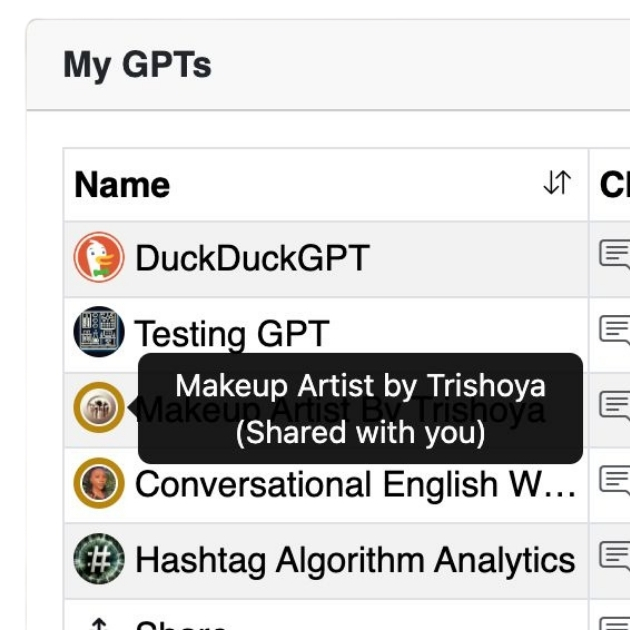
- Cosmetic Formulation & Development — Dr. Odongo has long been interested in medicinal and herbal plants, and how biotechnology can be used to develop products from natural ingredients. He noticed a growing interest in “green” or plant-based cosmetics, but also understood how that posed a major quality-control challenge: if the wrong ingredients or formulations are used, the end product is not only ineffective — it may also be harmful. His cosmetic formulation GPT is designed to help users think through ingredients, specifications and formulation considerations more carefully.
Publishing & Monetising GPTs
After building GPTs to solve his own research challenges, Dr Odongo realised that other people could benefit from the same tools, and decided to publish them to the OpenAI GPT Store.
He also installed Top Road's GPT Tools for analytics and monetisation.
Through the analytics feature, Dr Odongo has been able to see where his users are coming from. One of the most encouraging parts of the journey has been seeing users from Europe and the United States discover, use and share positive feedback about the GPTs he's built.
He's also started to add subscription paywalls to some of his more popular GPTs, and has generated over $1,000 in earnings so far.
What's Next
Dr Odongo's focus now is on improving the quality of output from his GPTs and exploring how they can become the starting point for more advanced AI-powered products.
He is interested in connecting custom GPTs to external models has has been experimenting with training models on platforms like Hugging Face and is considering building more comprehensive standalone software. One example could be a more advanced version of his cosmetic formulation GPT as this has had the highest traction in terms of revenue, and this validation of demand gives him the market signal to spend the extra time and investment. In that sense, custom GPTs can function as a practical MVP: a way to prove that a niche problem matters, that users are willing to engage with a solution, and that there may be a path to a larger product over time.
Dr Odongo's story shows what becomes possible when deep scientific expertise meets accessible AI tooling. By starting with real problems from his own field, building focused GPTs around specific workflows and using monetisation tools to reach paying users, he has turned specialist knowledge into AI products with global reach.
Watch the full interview with Dr Odongo over on YouTube: